The first thing Rome does is humble you.
You step off the plane expecting a city, and instead you find a civilization — layered, breathing, and utterly indifferent to your schedule. Emperors built here. Saints bled here. Artists went mad trying to capture it. And now you are standing in the middle of it, gelato in hand, wondering how a single city can carry so much weight and still feel so effortlessly alive.
Rome does not ask you to admire it. It simply exists, and that is enough.
The Colosseum hits differently in person. No photograph — not even the best one you have ever seen — prepares you for the scale of it. You round a corner on the Via Sacra and there it is, filling the sky, ancient and enormous, its arches stacked like the vertebrae of some great creature that refused to die. Seventy thousand Romans once roared inside those walls. You can still feel the echo of it in the stone.
Inside, you walk the same corridors the gladiators walked. The arena floor is partially reconstructed, and standing at its center, looking up at tier after tier of travertine limestone, you understand why history chose this place to write some of its most dramatic chapters.
But Rome is not only monuments. It is the neighborhoods that steal your heart.
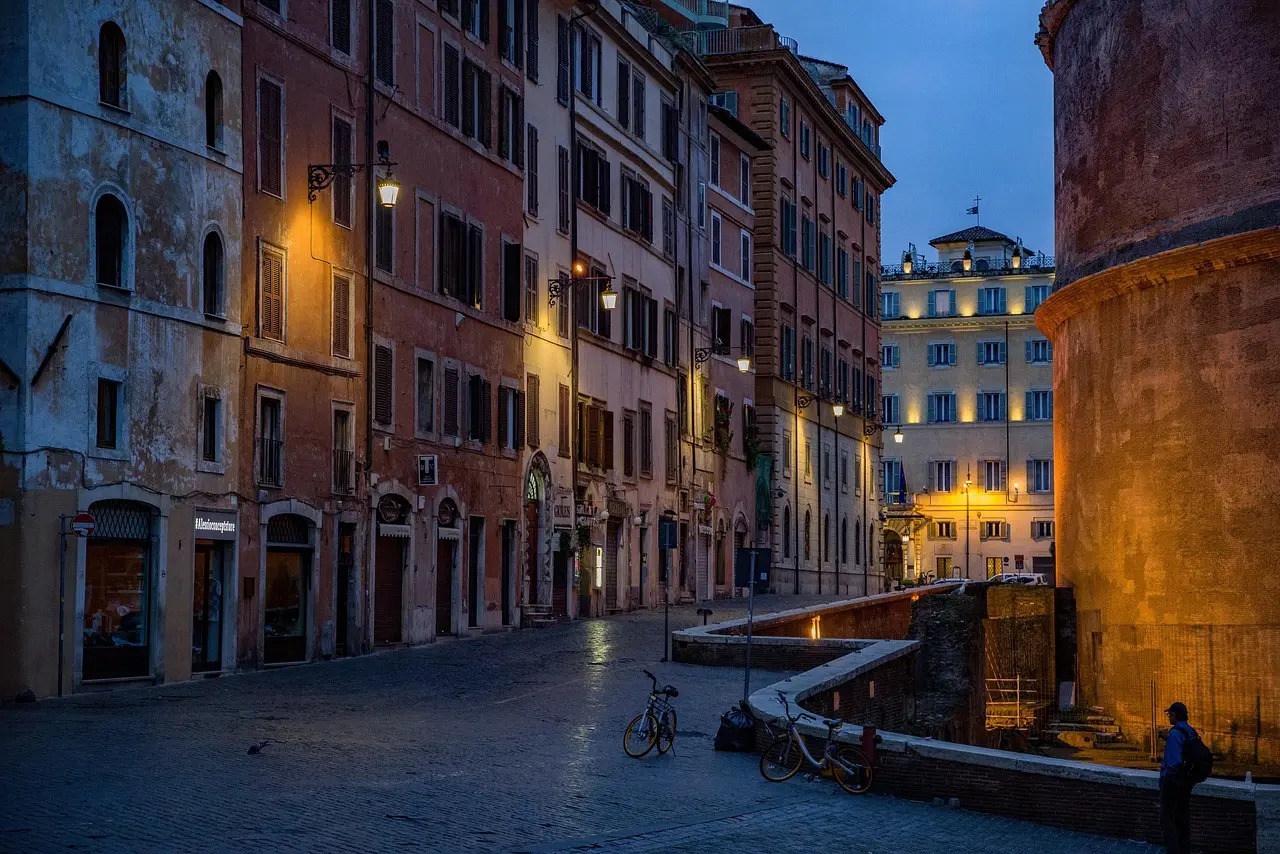
Trastevere at dusk is one of the most beautiful things Italy offers. The cobblestones catch the fading light, turning amber and gold. Laundry hangs between ochre-washed buildings. A fountain burbles somewhere you cannot see. Old men play cards outside a bar that has probably been there since before your grandparents were born. The restaurants here have no menus posted outside — just the smell of garlic, olive oil, and wood smoke drifting into the alley, doing all the advertising necessary.
You eat cacio e pepe the way it was meant to be eaten: simply, slowly, with a glass of house red and absolutely nowhere else to be.
The Vatican deserves a full morning, or more. The Sistine Chapel is, paradoxically, both smaller and more overwhelming than expected. The ceiling presses down on you with its impossible detail — Michelangelo spent four years on his back painting it, and every hour of that suffering is visible in the brushwork. Stand long enough in the silence and you feel the weight of all the eyes that have looked up before yours.
St. Peter's Square at sunrise, before the crowds arrive, is one of those rare travel moments you file away permanently. The colonnades spread their arms around you like a cathedral that forgot to put on its roof. The dome glows. A priest crosses the piazza alone. The city is just waking up.
Then the road north opens, and Tuscany begins.
The landscape changes so gradually you almost miss it — until suddenly you are in it, and you cannot imagine being anywhere else. Rolling hills stitched with vineyards and olive groves. Farmhouses perched on ridgelines like punctuation marks. Cypress trees standing in rows like sentinels on a road that leads, always, somewhere beautiful.
Florence greets you with the Duomo — Brunelleschi's impossible dome rising above the rooftops like a dare that somehow got answered. The Uffizi Gallery holds Botticelli's Birth of Venus and Primavera in the same room, and the experience of standing before them is one of the most quietly staggering things travel can offer. You have seen these images a thousand times on screens, in textbooks, on tote bags. Nothing replaces the real thing.
The Ponte Vecchio at golden hour is worth every tourist jostle. The bridge, lined with jewellers' shops since the 16th century, glows orange over the Arno while the hills above the city turn violet. Couples pause mid-walk. Photographers lose count of their shots. You understand, again, why people return to Italy their whole lives.
In the Chianti countryside between Florence and Siena, time slows to something closer to its natural pace. You take a wine road through Greve in Chianti, stopping at a family estate where the owner has been making the same Sangiovese blend for thirty years. He pours without measuring. He talks about the soil the way other people talk about old friends. The wine tastes like the landscape — earthy, honest, warm.
San Gimignano, the medieval hill town of towers, appears on the horizon like something from a fable. Fourteen towers still stand — what were once 72 symbols of family wealth and rivalry, now a skyline that belongs to another century entirely. The town is small enough to walk in an hour, old enough to make that hour feel like a passage through time.
And then Siena, its fan-shaped Piazza del Campo one of the great public spaces on earth. Sit at a cafe on the curved edge of the square, order a coffee, and watch the light move across the terracotta bricks as the afternoon deepens. Children chase pigeons. A couple argues cheerfully in Italian. A dog sleeps in a sliver of shade. The world is, in this moment, exactly the right size.
What Italy gives you, ultimately, is permission.
Permission to eat without guilt, to walk without destination, to sit in a piazza for two hours doing nothing of consequence and feel that you have spent the time well. The Italians have understood for centuries what the rest of the world is slowly learning — that a life savored is a life well lived.
You leave Rome with flour on your hands from a pasta-making class in a Trastevere kitchen. You leave Tuscany with a bottle of Brunello you cannot afford to drink yet and a photograph of a vineyard at sunrise that will serve as your phone wallpaper for the next six months.
You leave, already planning when to return.
Plan a Trip to This Destination
Let our travel experts craft the perfect itinerary for you.
View Packages →