The flight into Leh feels less like arrival and more like awakening.
As the plane cuts through thin Himalayan air, the window reveals a dreamscape — vast ribs of stone streaked with snow, rising toward a sky too close, too blue, too infinite. The mountains here don't simply stand; they seem to watch. Each ridge feels ancient and conscious, as if it remembers every traveler who ever dared to cross its spine.
When the plane lands, the wind carries a chill that feels like purity itself. The air is sharp, clean, almost holy. Breathing here is not passive — it is an act of reverence. The altitude forces you to slow down, to listen to your own pulse, to let go of the hurried rhythm you carried from the plains. Leh sits quiet in the cradle of these mighty guardians, a mosaic of whitewashed homes, prayer flags, and the murmur of bells from distant monasteries.
That first evening, I wander through the market square. There is laughter — gentle and warm, not loud. Women in woolen shawls sell apricots and turquoise jewelry. Monks move silently between the stalls, their maroon robes brushing the dust. The scent of butter tea mingles with that of juniper smoke. A child runs past holding a kite shaped like a dragon, and for a moment the entire world seems to breathe in rhythm with the flutter of its paper wings.
The next morning I set out toward Thiksey Monastery. The road winds upward, carved into the mountain's side like a grey thread. Below, the Indus River glimmers — a silver snake curling through a desert of stone. Thiksey rises from the slope like a white dream, tiered and serene, its golden spires catching the morning light. Inside, the air is thick with incense. Butter lamps flicker in quiet devotion. A young monk smiles shyly and offers me salted tea. It tastes strange but comforting — like something meant not for pleasure, but for endurance.
Ladakh wears its Buddhism openly and without performance. It is in the mani walls — long rows of stones carved with sacred mantras, placed by pilgrims along every road and mountain path. It is in the chortens that mark the hilltops, silhouetted against a sky so intensely blue it seems almost artificial. It is in the rhythm of daily life here, which moves not by the clock but by the light, the season, and the slow turning of the prayer wheel.
In the village of Alchi, one of Ladakh's oldest monasteries sits beside the Indus, its walls painted with 10th-century murals in colours that have no business surviving this long. Shades of lapis and vermillion and gold, still vivid after a thousand years. A caretaker monk watches me study them with patient, unreadable eyes. He has seen many visitors stand exactly where I am standing, trying to understand what they are looking at. Perhaps it cannot be understood. Perhaps it only needs to be witnessed.
From Leh, the journey deepens toward Pangong Tso.
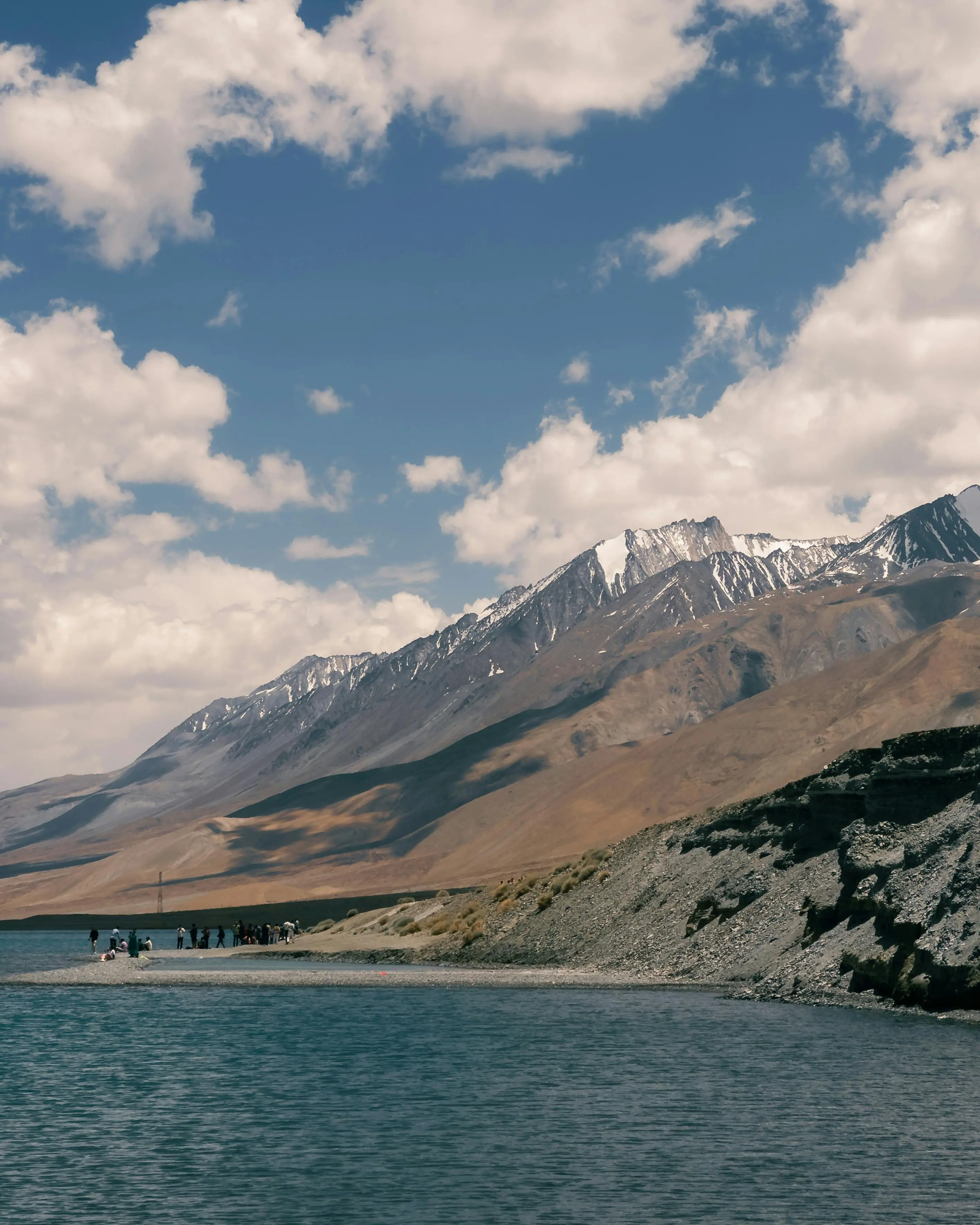
The road to Pangong is less a path and more a promise — long stretches of gravel and wind, dotted with yak herders and prayer stones. Every few kilometres the landscape changes its skin — brown to gold, gold to white, white to a blue so piercing it almost hurts the eyes. The silence here is not empty. It is alive, humming with a low, ancient vibration.
At Chang La Pass, one of the highest motorable passes in the world, prayer flags snap wildly in the wind. The signboard reads: You are at 17,688 feet. I stand still, dizzy not from height but from awe. Clouds drift below me like lost ships. The mountains stretch endlessly, raw and unashamed. In that moment I understand why people call Ladakh the Land of High Passes — not just because of its geography, but because every journey here feels like a passage through yourself.
When I finally reach Pangong, the world turns into colour.
The lake lies vast and still, holding the sky in its heart. Its surface changes hue with every breath of the wind — turquoise, sapphire, emerald, steel. It is as if the lake is painting and erasing itself in the same stroke. The air is thin and quiet. There are no crowds, no noise, no urgency. Just water, mountain, and the particular kind of peace that only arrives when you are very far from everything familiar.
I sit on the bank for a long time. A flock of bar-headed geese flies low across the water, their reflections ghosting below them. Somewhere behind me a nomad family has pitched their black yak-hair tent, a thin line of smoke rising into the cold afternoon air. They have lived like this for generations — following the seasons, reading the sky, needing very little of what the modern world insists is necessary. It is one of the most instructive things I have ever witnessed.
The route back to Leh takes me through the Nubra Valley, a lush oasis of sand dunes and apricot orchards tucked between two mountain ranges. Its gateway is Khardung La, one of the highest motorable roads on earth — a place where the wind is so fierce it pushes you sideways and the views are so vast they push you inward.
In Nubra, double-humped Bactrian camels graze beside the Shyok River, a living reminder that this valley was once a corridor on the ancient Silk Route. Caravans passed through here for centuries, carrying silk, spice, and stories between Central Asia and the Indian subcontinent. The mountains absorbed all of it. They remember.
The village of Turtuk, near the Pakistan border, is one of the most remote and remarkable places on the entire route. It was only opened to visitors in 2010 and still carries the unhurried quality of a place that has not fully decided what it thinks of tourists. The people here speak Balti, grow the sweetest apricots in Ladakh, and live in stone houses with flat rooftop terraces stacked with firewood for the long winter ahead. Children follow you through the narrow lanes with the frank, fearless curiosity of those who have seen few strangers and are not yet tired of them.
The last evening in Leh, I climb to the Leh Palace as the sun sets over the Zanskar Range. The town below turns gold. The mountains turn violet. The prayer flags — red, white, blue, green, yellow — flutter in the last of the day's wind, carrying their mantras outward into the enormous sky.
Tibetan Buddhism teaches that prayer flags do not carry wishes to the gods. They carry blessings outward, on the wind, for the benefit of all beings in all directions. Standing there, watching the light leave the mountains one colour at a time, I think there are worse philosophies to travel by.
Ladakh does not let you leave unchanged. It takes something from you — your hurry, your noise, your assumption that the world moves at your pace — and in its place leaves something quieter and more durable. A different sense of scale. A deeper ease with stillness. The understanding that some of the most important journeys are the ones that bring you to a complete stop.
You will come back. Everyone does.
Plan a Trip to This Destination
Let our travel experts craft the perfect itinerary for you.
View Packages →